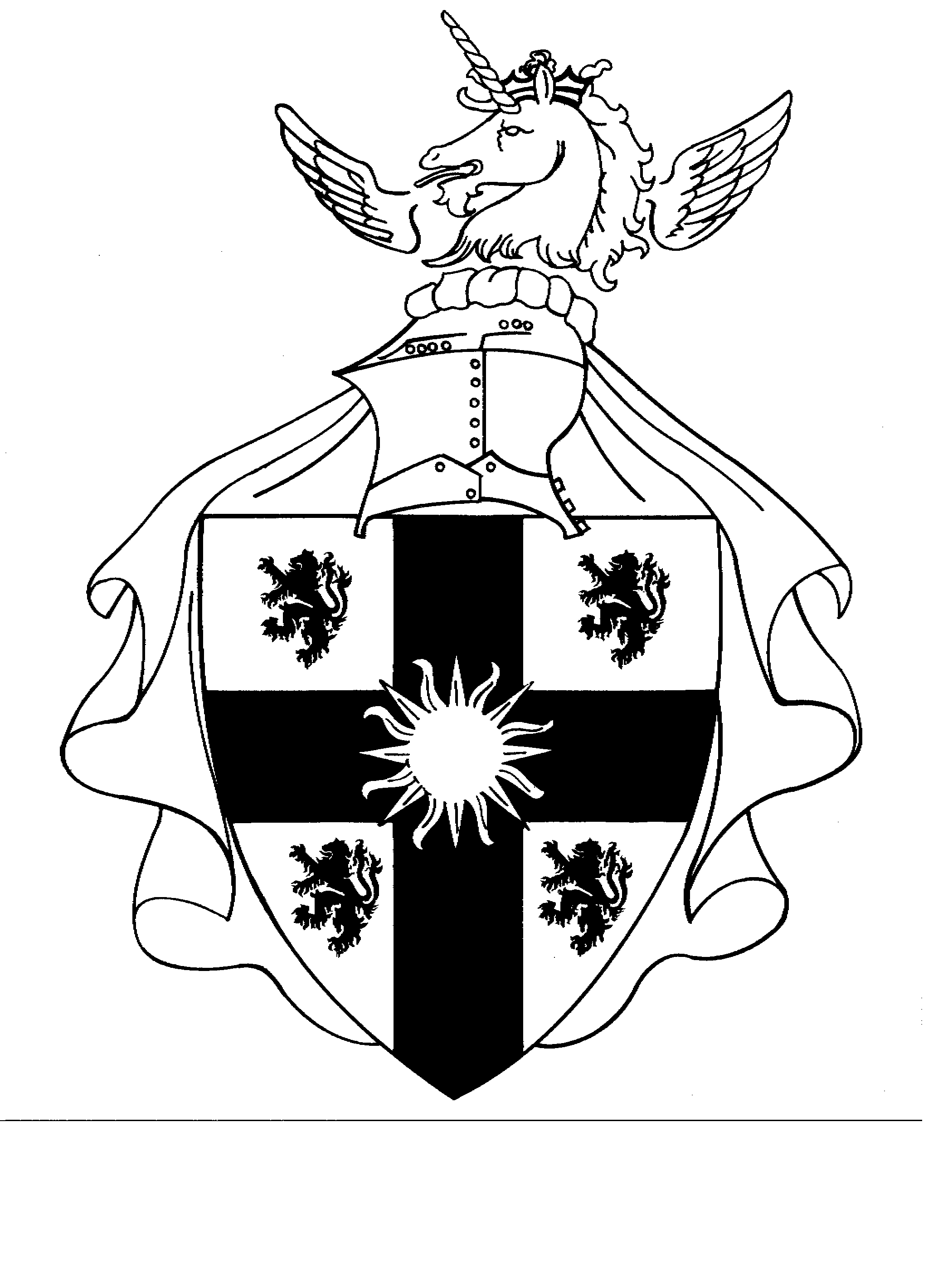
This coat of arms was granted in 1614 to George Wells of Caius College (it is noted as
"Keyes" in the grant), Cambridge. He was the son of a Roger Wells and matriculated at
Caius College in 1596/7. He became a priest in 1608 and from that date until 1642 was
Rector of Beetley in Norfolk. He was buried at Beetley (we do not have the date). This
grant of arms was made by William Camden, Clarenceus King of Arms and, according to
the College of Arms records, the coat of arms was quite specific:
"Blazoned: Or on a cross between four lions rampant double-tailed sable, a sun radiant or.
The crest is a unicorn's head erased azure, the horn, mane and coronet or, between two wings also or".
In layman's terms, this is a shield with gold background, a black cross with four black lions attacking, one in each quarter each with a double tail. In the center of the cross is a gold sun with rays emerging from it. The crest is a blue (azure) unicorn's head with a gold horn and mane with gold wings on each side and a gold crown upon the head.
The lions and cross are a single composition and do not represent quarterings (marriages between noble families). The cross was commonly used in coats of arms granted to church leaders.
It is unfortunate that there is no other information available on this specific family, but it would normally seem likely that as a priest George Wells would have left no children. However, in the London visitation of 1633/34 a Thomas Wells is found "of Gissing, Norfolk" with virtually the same coat of arms. The visitation shows Thomas Wells and wife Clemens Barker having a son Thomas Wells, a citizen and mercer.
His first wife, was Margaret, widow of Moyle Deale. They had one son Thomas Wells who was dead by the visitation. His second wife is recorded as Ann, widow of Henry Watts with no children. A notation made at the visitation shows the identical coat of arms except that the lions have single tails rather than double. An additional notation made at this visitation indicates the coat of arms was granted in 1614 to a Thomas Welles, secretary to the then Bishop of Bath and Wells.
It is not clear whether or how this latter Thomas Wells was connected with the Gissing and London family. Nor is it clear whether the family was properly entitled to use the shield and crest. It is also not clear if there was any connection between any of these people and the original George Wells.
Further, in Burkes Landed Gentry, Vol 2, 1846 there is a Wells of Boxford recorded as descended from this same family. The lineage recorded here was:
John Wells (cir 1710) married Sarah and had:
The son of George and Frances Wells, George Wells, married in 1796 Elizabeth Hinton, daughter of Rev. John Knight Hinton, of Chawton, Hants. and 2nd, in 1835, Frances Ballard {we wonder if there is not an error on the name here}. The children of George Wells and Elizabeth Hinton were:
The son of George and Elizabeth Wells, the Rev. George Wells of Boxford Rectory, Kent, was born 19 Mar 1803 and married 04 Aug 1835 Augusta Starky of Spye Park, Wiltshire. Their children were:
There have been many drawings published of a similar coat of arms showing a single lion in the upper left quadrant. This is not supported by any information in the College of Arms (i.e it is not authorized). My guess is that the drawing of the coat of arms was started by a latter day artist who, after completing only one of the four lions, did not finish his drawing for some reason and it was propagated from one work to another.
The rendition of this coat of arms with the single lion has been used for many years by the Welles Family Association, Inc. of Wethersfield, Connecticut having been adopted about 1936. However, they acknowledge that there is little likelihood that the Governor Thomas Welles was of an armorial family although there is a tradition of a tankard that carried a coat of arms having been in the family in earlier years.
What we are clearly missing here are details of both the ancestors and the descendants of this family as well as the linkage between the first George Wells to whom the grant was made, the Gissing and London family of Thomas Wells, Thomas Wells the secretary, and the more recent family listed in Burke's landed gentry. We welcome any further input on this/these line(s).
e-mail: Wells Family Research Association
OrinWells@wells.org