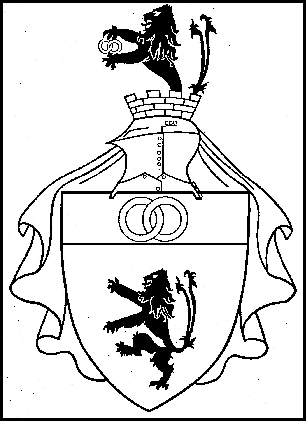
This coat of arms is a curious one that has been attributed to some early American families, but according to the College of Arms in London, the authority for English Arms, it was first granted in 1838 to the Rev. Samuel Wells, Rector of Portlemouth in Devon and magistrate for that county. He was the fourth son of the late Rev. Nathaniel Wells, Rector of East Allington in Devon. The right to this Coat of Arms was granted to all the direct male descendants of the Rev. Nathaniel Wells.
The heraldic description of this coat of arms is: "Or a lion rampant double-queued sable, on a chief gules two annulets interlaced or." The Crest is described as: Out of an embattlement proper a demi-lion double-queued sable holding between the paws two annulets interlaced or. In contemporary terms, this means on a field of gold, a lion attacking, double tailed black, on the red upper third of the field two gold rings interlaced. The crest contains a black half lion with double tails holding between the paws two interlaced gold rings and rising out of a stonework crown in it's natural colors.
The Grant of the Arms in 1838 stated that the family had used Arms "for several generations", but such Arms were not registered for them, so the new Grant was necessary.
The Genealogical information on the family is as follows: 1. Samuel Wells of the City of Oxford. Children of Samuel Wells included:
Edmund Wells b: 25 August 1752, baptised 10 October 1752 at East Allington. Inherited in 1768 Fallapit, the manor of East Allington, Preston Croft and other estates for the Fortescues of Fallapit, county Devon from his great aunt Elizabeth Fortescue. Buried on 10 Oct 1779 at East Allington.
Edmund married 23 November 1770 at East Allington, Mary Anne Blundell, daughter of Peter Blundell of Collipriest, county Devon. She married secondly, Edward Calvert of Albury Hill, county Hertforshire and was deceased in 1838. There were children of this marriage.
The children of William Wells and Elizabeth Pearse were:
Samuel and Elizabeth had 4 children:
Of the children of William Wells and Elisabeth Pearse, the only son was William Bury Wells (b: 15 April 1782, d: 23 November 1834). He was buried at St. Anne, Limehouse, County Middlesex. William married Jane Pearse (b: 25 Aug 1779, was deceased in 1838) on 24 April 1811 at South Moulton.
Their children were:
Of the children of Samuel Wells and Elizabeth Lake:
Fortescue Wells, Captain in the Royal Regiment of Artillery (20 September 1790 - 29 September 1861) married Ann Hepworth (13 July 1824 - 23 April 1870) of Pontefract, county York and had two daughters:
Rev. Thomas Bury Wells (17 January 1795 - 23 May 1879) married Catharine Frances Stockdale (22 January 1816 - still living in 1838) on 23 March 1841. Thomas Bury Wells served in the Royal Navy and was at the Battle of Algiers.
Their children were:
Of these, Lionel Bury Wells married Mary Eliza Kirkman of Croft cum Southwork, County Lancaster (21 April 1847 -) 11 October 1871 at Croft.
Their children were:
The above information is from the College of Arms records. There is little likelihood that any American family can claim descent from this specific family.
However, what is "curious" is the statement in the grant papers that the family had used arms for "generations". On page 81 of the Armorial Addenda of the American Armoury and Blue Book edited and published by John Matthews, London England 1906, this same coat of arms is shown as belonging to the Governor Thomas Wells (1598 - 1660) 4th governor of Connecticut. There is no authority cited though.
In addition, his descendants, the current Wells Family Association, Inc. based in Wethersfield has been using another coat of arms depicted on the same page which we will discuss in a later issue.
In the book The Wells Family printed by the American Genealogical Research Institute in 1973 (a work completely without authority) it is stated that this coat of arms was attributed to Francis Wells of Cambridge, Massachusetts "who was recorded among the gentlemen of coat armor in that colony in 1736". This work does not cite authority nor source so we have no idea where they came up with this claim. It also references the right by Governor Thomas Welles no doubt from the Matthews work.
If any of our readers knows of such a 1736 Massachusetts record, we would be delighted to see a copy of any Wells entries. In fact, we would like to see any information any of our readers knows about concerning early American "gentlemen of coat armor". Is there any evidence (seals on documents, original seals, coats of armor, book plates, etc.) or other early evidence of such? If you have any of this information please contact the Association.
Does anyone know of the existence in the US or Canada of an old tankard on which is emblazoned a Wells coat of arms? One is supposed to have existed and to have been passed to the grandson of Governor Thomas Welles and has never been heard of again.
e-mail: Wells Family Research Association
OrinWells@wells.org